首頁 > KNOWLEDGE > Polishing products > Say Goodbye to Orange Peel and Sandpaper Marks: ALOMAX Paint Micro-Leveling Technology
Say Goodbye to Orange Peel and Sandpaper Marks: ALOMAX Paint Micro-Leveling Technology
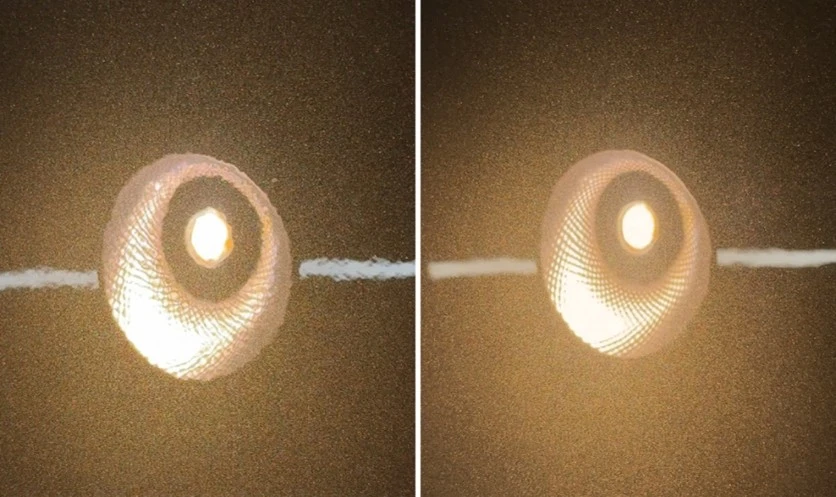
1. Analyzing Paint Restoration: Labor & Resource Losses Under Multi-Stage Repeated Sanding and Polishing
After new car factory painting or refinish repainting, irregular wave-like surface textures are frequently observed on the Clear Coat layer. In the automotive industry, this is known as "Orange Peel." Alternatively, fine yet dense 1500–3000 grit sandpaper marks are often left behind after spot sanding defects.
When addressing these deeper defects, conventional restoration methods usually require trade-offs between two major concerns:
- Frequent Tool Switching (High Equipment Cost & Wasted Labor Hours): Heavy cutting requires large orbit Dual Action (DA) polishers or high-cutting Rotary (RO) polishers, whereas subsequent grit reduction and mirror polishing require switching to small orbit polishers or soft backing plates. Restoring a single vehicle often requires swapping between 2 to 3 different machines.
- The Illusion of False Cutting (Quality Hazards of Oil-Based Compounds): Many traditional polishing compounds contain silicone oils or fillers. While sandpaper marks seem to "disappear" during application, the oil merely fills the scratches (false cutting). After 2 to 3 car washes or exposure to sun heat, the oils wash away, exposing the hidden defects again.
2. Core ALOMAX Multi-Use Technology: Seamless Transition from Heavy Cutting to Mirror Finish
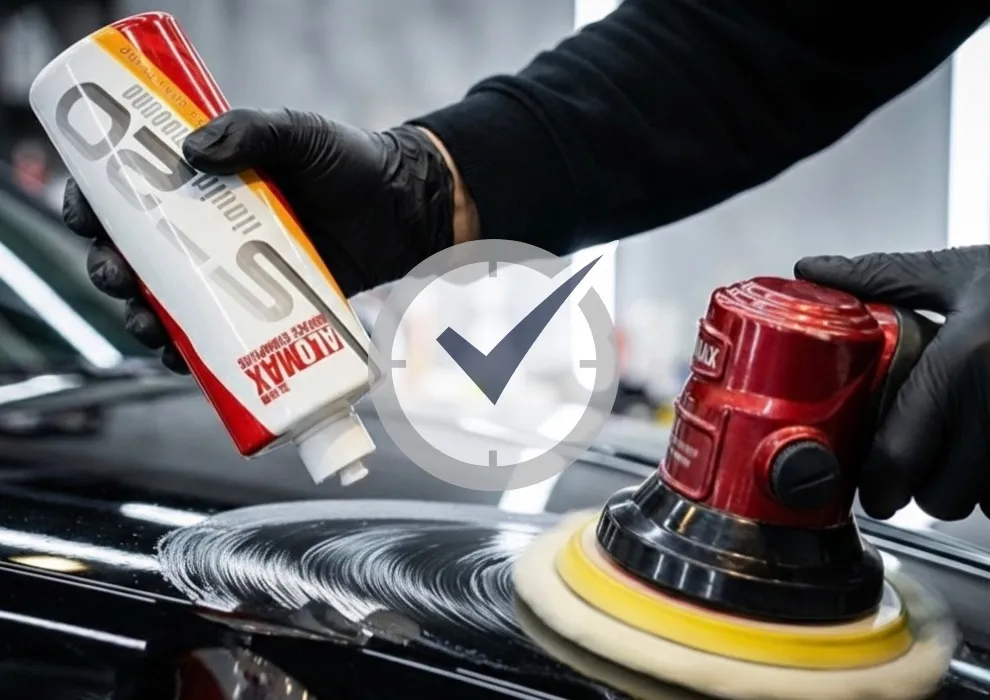
Combining precision equipment configurations with the unique physical properties of water-based compounds, ALOMAX breaks away from the traditional concept that "heavy, medium, and fine polishing must be rigidly separated across different machines."- High Kinetic Energy Conversion & Stable Orbit: Paired with ALOMAX compounds and polishing pads, the polisher maintains a stable movement track even under heavy cutting force. From leveling 1500+ grit sandpaper marks to fine color restoration, there is no need to switch to a second polisher.
- Decreasing Abrasive Technology (DAT): ALOMAX water-based compounds utilize micro-crystal particles that deliver powerful physical cutting action initially. Under the pressure and friction of operation, these particles self-disintegrate into finer polishing molecules, automatically transitioning into the mirror-finishing stage.
3. Standardized SOP Application Process
- Step 1: Deep Paint Cleaning & Sanding Prep
(Prerequisite: Fully remove iron filings and tar to prevent secondary scratches.)
Wash the vehicle thoroughly with a pH-neutral shampoo, and use a clay bar to remove iron particles and overspray on the clear coat surface. - Step 2: Single-Machine Switch — ALOMAX Water-Based Cutting Technology
(Key Operation: Keep temperature low, maintain steady pressure and speed for surface leveling.)
Select the ALOMAX polishing equipment with the matching pad, apply a proper amount of ALOMAX water-based compound. Spread evenly at low speed, then increase to medium-high speed using a cross-hatch pattern to quickly level out sanding scratches. - Step 3: Micro-Crystalline Finishing & Mirror Polish
(Key Operation: Leverage particle breakdown to switch directly into fine polishing.)
Without changing machines, lighten the downward pressure slightly and utilize the broken-down fine abrasives to refine the surface, raising gloss levels above 85 GU for a rich, high-definition mirror finish. - Step 4: Strict IPA Degreasing Inspection
(Inspection Standard: Verify 100% real cutting power, reject oil concealment.)
Spray IPA (Isopropyl Alcohol) degreaser over the area and wipe clean with a microfiber towel. Under high-intensity inspection lights, confirm that no residual grooves or false concealment remain.
4. Traditional Oil-Based Compounds vs. ALOMAX Water-Based Technology
| Evaluation Item | Traditional Oil-Based Polishing Waxes | ALOMAX Water-Based Technology |
| Primary Cutting Principle | Relies on coarse physical abrasives + oil filler concealment | Physical micro-crystalline precision cutting and leveling (Physical Restoration) |
| Equipment Requirement | Requires swapping between 2–3 polishers of different specs | Multi-use in one polisher; just adjust speed and pad to complete |
| Post-IPA Inspection | Sandpaper marks and fine scratches reappear as oils wipe off | Defects do not rebound; reveals real clear coat smoothness |
| Dust & Cleanup | Sticky dust, oily residual hard to clean; affects coating adhesion | Water-based, easy to wipe, non-sticky dust; ready for direct coating |
💡 Paint Orange Peel & Sandpaper Mark Repair FAQ
Q1: Why is an IPA wipe inspection mandatory after using ALOMAX water-based compound?A1: Traditional polishing compounds contain suspending agents and fillers that fill in sandpaper marks and micro-grooves, creating an illusion that defects are gone (false cutting). ALOMAX emphasizes 100% true physical cutting. Wiping down with IPA washes away residual media, confirming that defects are physically leveled rather than masked by oils, ensuring no scratch rebound after washing.
Q2: Does ALOMAX "Multi-Use" technology truly eliminate the need for a second polisher?
A2: Yes! ALOMAX water-based compound utilizes Decreasing Abrasive Technology (DAT). It delivers strong initial cutting force to level 1500-grit marks, then automatically breaks down into micro-molecules for mirror polishing. By simply adjusting speed or changing pads, you can transition smoothly from heavy compounding to high-gloss mirror finishing, saving tool switching costs and working time.
👉 Watch Demo Short: https://youtube.com/shorts/AKYmi1WX8hk?si=RfxaNkxRZpbyBuvc
-
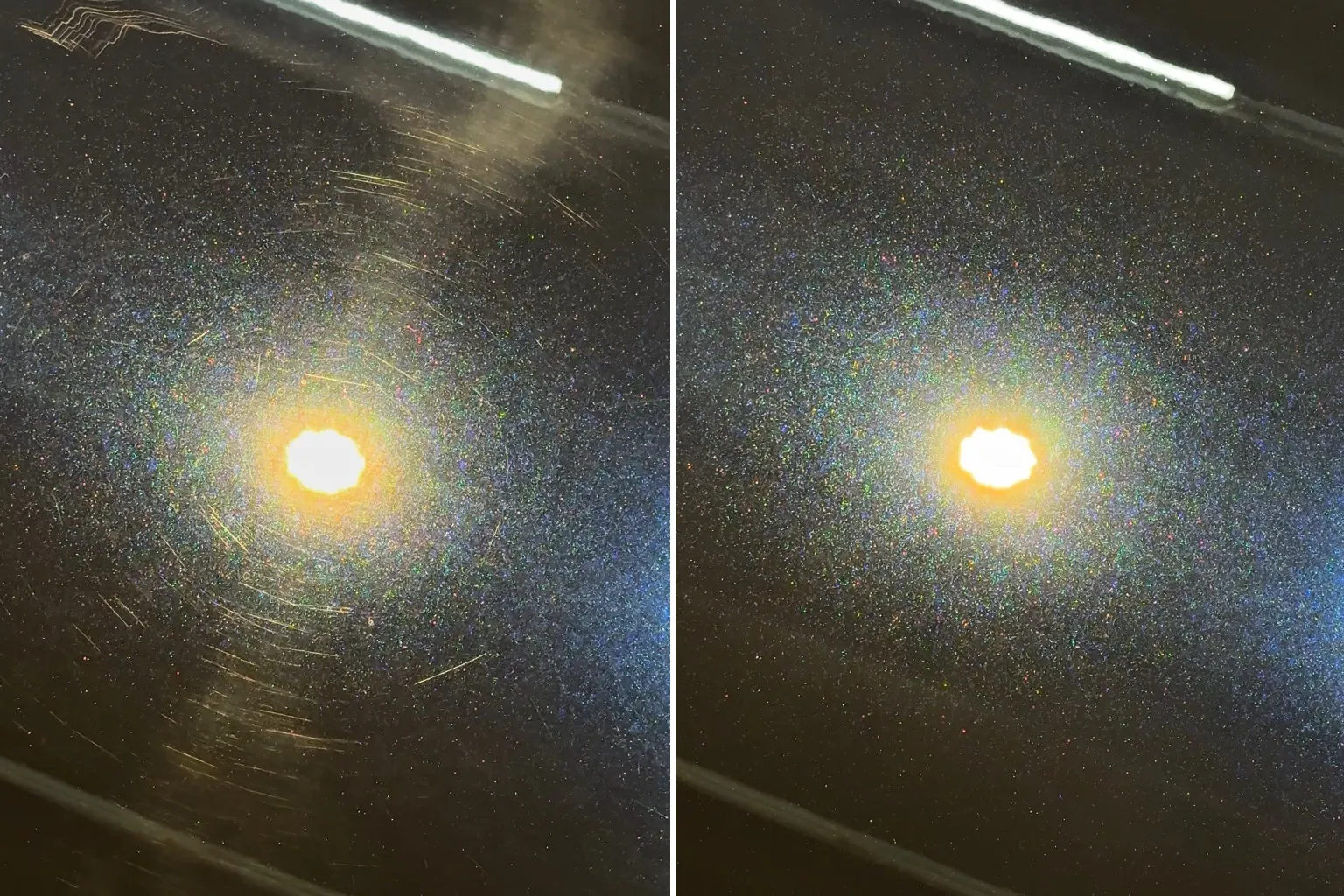
Why choose ALOMAX? Experience the real strength of our water-based cutting compounds!
-
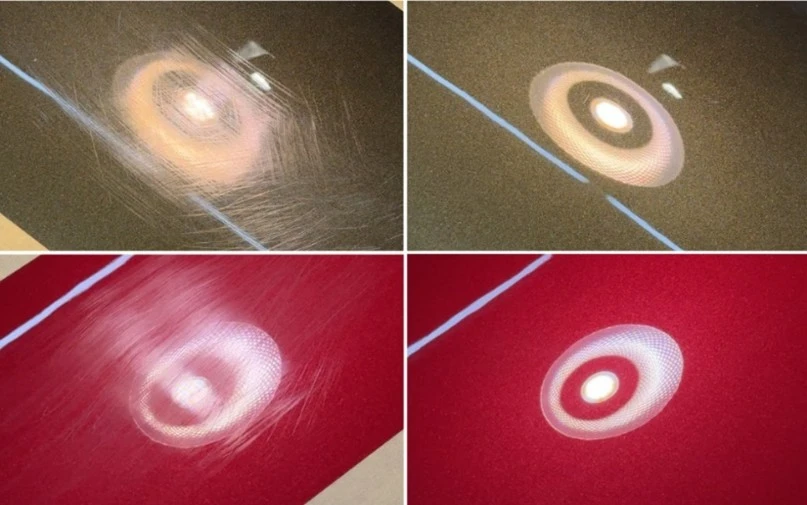
How to Handle Severe Scratches? ALOMAX "Grinding Over Heavy Polishing" Craftsmanship for Safe and Efficient Mirror Finis
-
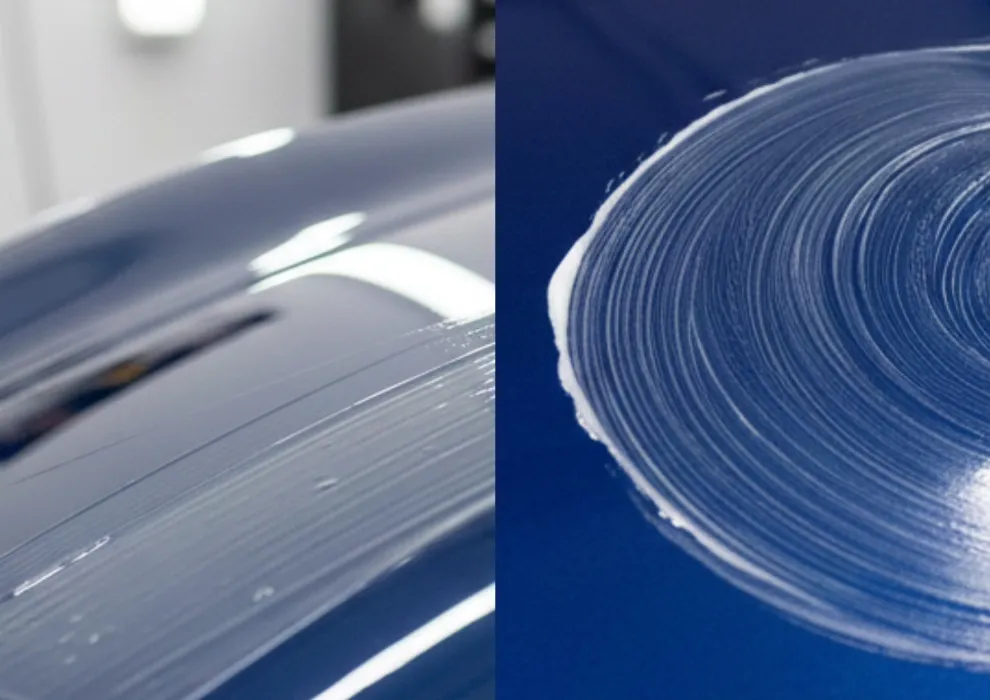
Why wax or coat after polishing? Understanding the vital role of a protective layer.
-
Why does ALOMAX's brilliance last? True shine doesn't rely on cover-ups.